Full G road test
What to expect on the G road test
The G road test is an advanced test of about 30 minutes that includes driving on major roads and expressways. Full-time DriveTest Centres currently give a modified test without parallel parking, roadside stops, 3-point turns or residential driving, while part-time Travel Points still give the standard G road test.
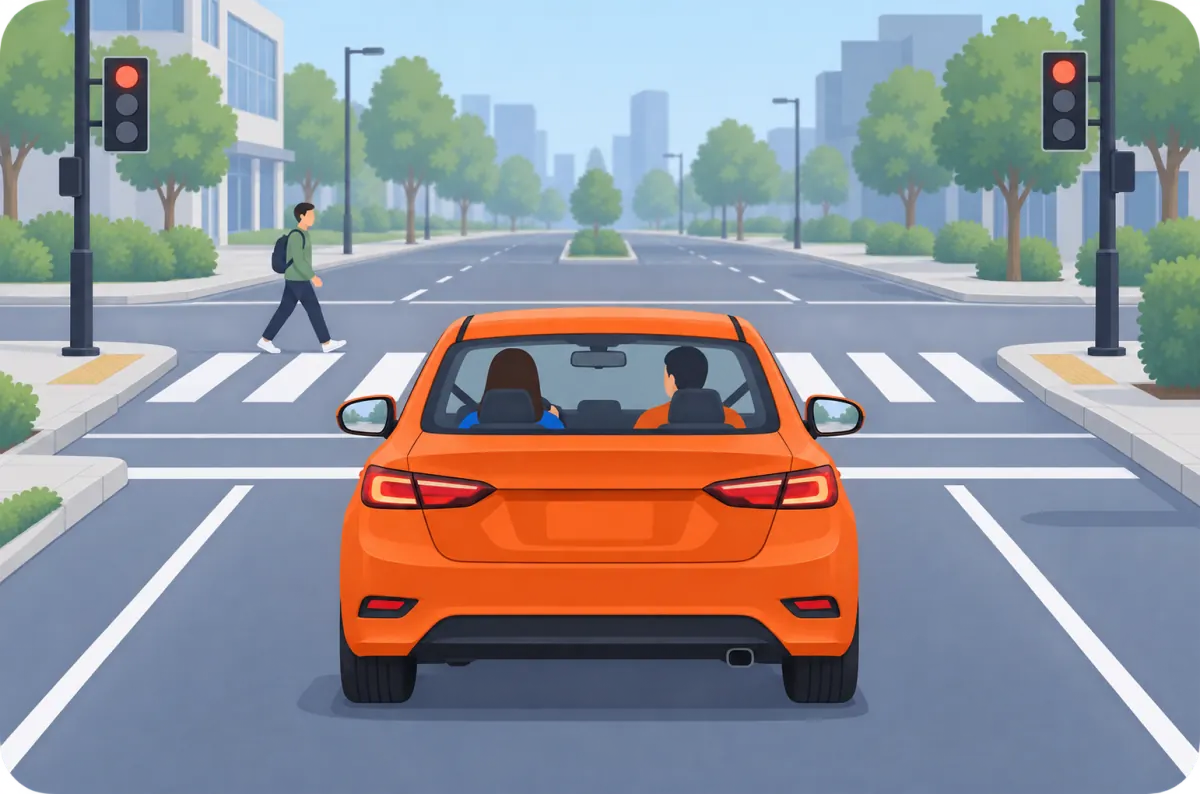
Two versions of the G road test
There are currently two versions of the G road test in Ontario, depending on where you take it. Until further notice, DriveTest has modified the G road test at full-time DriveTest Centres. Ontario.ca says the same modified format applies at temporary road test locations. Part-time Travel Points continue to offer the standard G road test.
| Modified G test | Standard G test | |
|---|---|---|
| Where | Full-time DriveTest Centres and temporary road test locations | Part-time Travel Points |
| Major roads and expressways | Yes | Yes |
| Turns, curves, lane changes | Yes | Yes |
| Intersections | Yes | Yes |
| Business areas | Yes | Yes |
| Parallel parking, roadside stop, 3-point turn, residential driving | No | Yes |
The modified test leaves out the four elements already covered on the G2 road test. It still includes all the fundamentals, including merging on and off expressways, keeping appropriate speed and space, and signalling. To check which locations offer the G and which are Travel Points, see our DriveTest centre guides.
What the examiner assesses
The examiner gives you directions and watches whether you carry out the actions the Official MTO Driver's Handbook lists for each driving task. The handbook describes the G road test (the Level Two road test) as a test of advanced skills that generally come with experience.
Here are the main tasks and what each one involves:
- Freeway entering: checking mirrors and blind spot on the ramp, signalling, matching freeway speed in the acceleration lane and merging smoothly into the centre of the nearest lane.
- Driving along the freeway: checking mirrors every 5 to 10 seconds, keeping a steady speed without speeding or driving unreasonably slowly, and leaving at least a two- to three-second gap.
- Freeway exiting: signalling before the exit lane, moving in at the start of it, and not slowing down until you are fully in the exit lane.
- Lane changes: looking all around, signalling, checking your blind spot once more and moving smoothly into the centre of the new lane.
- Left and right turns: approaching in the correct lane, signalling, controlling speed, turning with both hands and finishing in the matching lane.
- Stop and through intersections: full stops at the right spot, traffic checks left, ahead and right, and no lane changes inside the intersection.
- Curves: slowing to a safe speed before the curve and holding a steady line.
- Business sections: watching entrances, crossings and pedestrians, and choosing the safest lane for through traffic.
The standard G test at Travel Points can also include a residential section, a roadside stop, parallel parking and a three-point turn. For a deeper look at the highway portion, read highway driving for the G test.
How long the test takes
DriveTest says the G road test usually takes about 30 minutes. The G2 road test, by comparison, takes about 20. According to the handbook, every road test has a set time frame, and the examiner tells you how much time you have before you begin.
Test day, step by step
DriveTest asks you to arrive at least 30 minutes early. Road tests run in any weather unless you are told otherwise, so check DriveTest's service disruptions page on bad-weather days.
- Park, go inside and check in. Most centres have a self-serve kiosk.
- Return to your vehicle and wait for the driver examiner. If no one arrives within 30 minutes of your appointment time, go back inside to Counter A.
- The examiner walks around the vehicle to check for damage and safety hazards and may ask you to test signals and brake lights.
- The examiner explains the test. They are not allowed to coach you, so ask any questions before you start.
- You drive the route the examiner directs. You won't be asked to do anything illegal.
A few rules apply inside the car. No passengers or pets other than the examiner are allowed. In-vehicle recording devices, including phone and dashboard cameras, must be disabled. The handbook also says electronic driving aids such as cruise control, lane monitoring and back cameras may not be used, because you must show your own mirror and shoulder checks.
Your results
You get feedback right away. The examiner gives a brief verbal summary of your skills and completes a scoresheet against set criteria.
- If you pass: go back inside the DriveTest Centre to apply your result. You receive a temporary licence valid for 90 days or until your full G card arrives by mail. If you don't apply your result within 12 months, it is no longer valid. See what happens after you pass.
- If you don't pass: the scoresheet shows where to improve. You can retest while your G2 is valid, generally after at least 10 days, and the fee applies again.
If your test was done on a tablet, you can download your results within 15 days. Paper copies of the scoresheet are available on request within 13 months.
Get ready for the format
The best preparation is plenty of practice on busy multi-lane roads and expressways. The Roadity iPhone app gives you G practice routes near 19 Ontario DriveTest centres, with spoken turn-by-turn guidance and hints at highway entrances, merges and exits. It works with Apple CarPlay and Android Auto. Examiners choose the real route on the day, so use these routes to build skills, not to memorize a test. Download Roadity and review the free G road test checklist before your appointment.
Questions
How long is the G road test?
DriveTest says the G road test usually takes about 30 minutes. The examiner tells you the time frame before you start.
Is parallel parking on the G road test?
Not at full-time DriveTest Centres right now, where the modified G test drops parallel parking, roadside stops, 3-point turns and residential driving. Part-time Travel Points still give the standard G road test.
Can I use my backup camera or cruise control on the G test?
The Official MTO Driver's Handbook says driving aids such as cruise control, lane monitoring, automatic parking and back cameras may not be used. DriveTest allows a car that has a rear camera, but you still have to turn your head, check mirrors and look around.
When do I find out if I passed the G test?
Right after the test. The examiner gives you a brief verbal summary, and if the test was done on a tablet you can download your results online within 15 days.
Sources
- DriveTest: Road tests for cars, vans and small trucks
- Official MTO Driver's Handbook: The Level Two Road Test
- Official MTO Driver's Handbook: Getting Your Driver's Licence
- Ontario.ca: Get a G driver's licence: new drivers
- DriveTest: Road test vehicle requirements
- DriveTest: FAQs (rear cameras on road tests)
Checked November 8, 2026. Rules and fees can change; confirm with DriveTest or ServiceOntario before your test.