G1 knowledge test
Ontario Road Signs for the G1 Test
Ontario road signs fall into regulatory, warning, temporary condition, and information and direction signs, and their shape and colour tell you which type you're looking at. Learn the shapes and colours first, then the meanings, because the G1 knowledge test has a section on signs.
How Ontario road signs work
Ontario road signs use shape, colour and symbols so you can recognise them quickly. The Official MTO Driver's Handbook sorts them into four main types: regulatory, warning, temporary condition, and information and direction. A few signs have a unique shape so you can spot them from a distance.
DriveTest says the G1 knowledge test usually has a separate section on signs. Learn the shape and colour patterns first. Once you know them, you can work out a sign's general meaning before you even read it.
The four signs with unique shapes
These four signs are shaped differently from everything else on the road. Learn them cold.
| Sign | Shape and colour | What it means |
|---|---|---|
| Stop | Eight-sided, red background, white letters | Come to a complete stop |
| Yield | Triangle, white background, red border | Let traffic in or near the intersection go first; stop if needed |
| School zone | Five-sided, fluorescent yellow-green background, black symbols | Slow down, use extra caution, watch for children |
| Railway crossing | X-shaped, white background, red outline | Railway tracks cross the road; slow down, look both ways, be ready to stop |
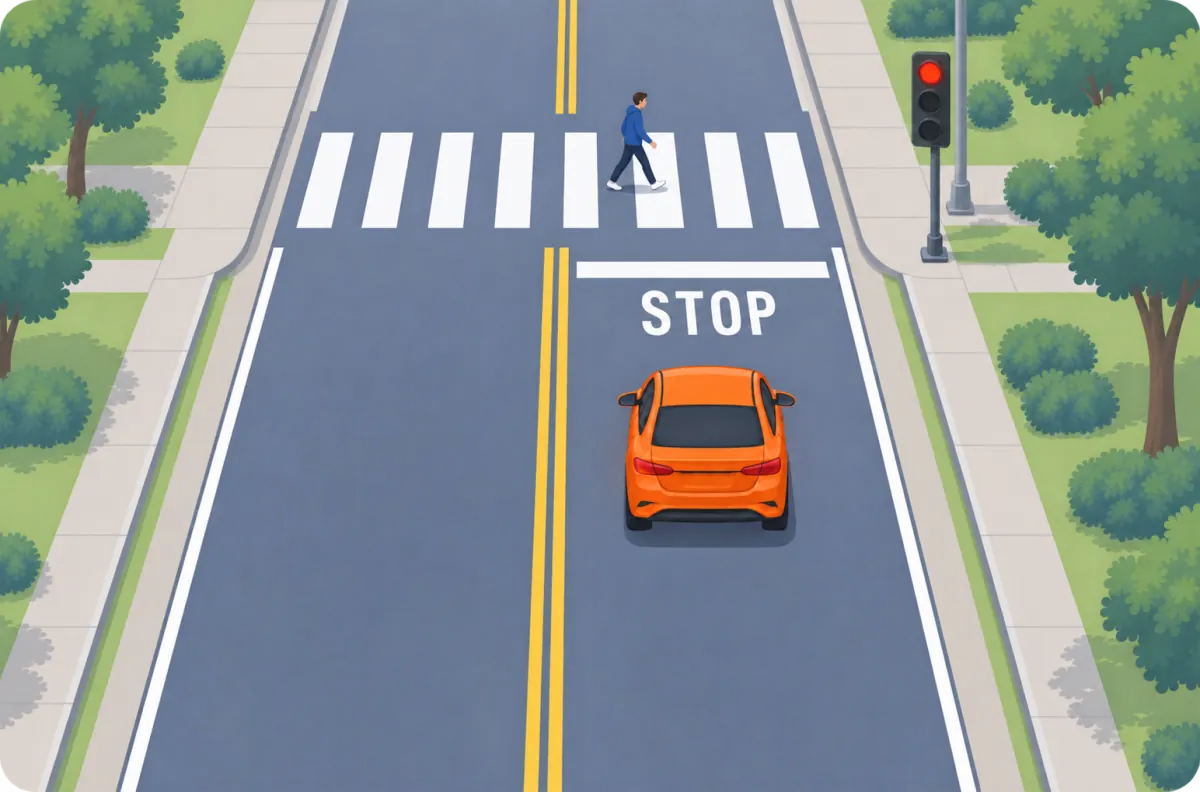
Where to stop at a stop sign: at the stop line if there is one. No stop line? Stop at the crosswalk. No crosswalk? Stop at the edge of the sidewalk. No sidewalk? Stop at the edge of the intersection. This order shows up throughout the handbook.
Regulatory signs
Regulatory signs give directions you must obey. The handbook says they are usually rectangular or square, with a white or black background and black, white or coloured letters.
Two symbols do a lot of the work:
- Green circle: you may or must do the activity shown inside the ring.
- Red circle with a line through it: the activity shown is not allowed.
Common regulatory signs include no left turn, no U-turn, no right turn on a red light, do not enter, do not pass, one-way, keep right of the traffic island, and lane-use arrows that tell each lane which way it must go.
Watch for the stopping and parking trio. They're easy to confuse:
- No stopping: you may not stop in the area between the signs, even for a moment.
- No standing: you may not stop except while loading or unloading passengers.
- No parking: you may not stop except to load or unload passengers or merchandise.
Other regulatory signs to know: community safety zones (traffic offences there carry increased fines), school zones with a lower speed limit when yellow lights flash, and pedestrian crossovers, where you must be ready to stop and yield to pedestrians.
Warning signs
Warning signs tell you about dangerous or unusual conditions ahead. The handbook says they are usually diamond-shaped with a yellow background and black letters or symbols.
Examples include sharp bends, winding roads, narrow bridges, steep hills, slippery-when-wet pavement, right lane ending, merging traffic, deer crossings, hidden school bus stops and traffic lights ahead.
A few details worth noting:
- A sign posted under a curve warning shows the maximum safe speed for that curve.
- A checkerboard border warns of danger at a sharp turn. Slow down.
- Chevron (arrowhead) signs are posted in groups to guide you around sharp curves.
- On a merge sign, drivers on both roads are equally responsible for merging smoothly and safely.
Temporary condition signs
Temporary condition signs warn about road work, detours, lane closures and traffic control people. They are usually diamond-shaped with an orange background and black letters or symbols.
Same shape as a warning sign, different colour. That's the detail to remember. One temporary condition sign tells you that speeding fines are doubled in a designated construction zone when workers are present.
Information and direction signs
These signs tell you about destinations, distances, exits and services. They are usually rectangular with a green background and white letters. Signs in other colours guide you to facilities, services and attractions.
A handy fact from the handbook: freeway interchange numbers match the distance from the start of the freeway. Interchange 204 on Highway 401 is 204 kilometres from Windsor, where the freeway begins.
Other signs to know
- Slow-moving vehicle sign: an orange triangle with a red border. The vehicle ahead travels at 40 km/h or less. Farm tractors and horse-drawn vehicles display it.
- Bilingual signs: in designated bilingual areas, read the message in the language you understand best.
Traffic lights, signals and markings
The signs section of the handbook sits alongside traffic lights, pedestrian signals and pavement markings. Know these too:
- Yellow light: stop if you can do so safely; otherwise, go with caution.
- Flashing red light: come to a complete stop and go only when it's safe.
- Flashing yellow light: drive with caution.
- Flashing green light or left green arrow with a green light: an advance green. You may turn left, go straight or turn right from the proper lane.
- Lights out in a power failure: treat the intersection like an all-way stop.
- Yellow lines separate traffic going in opposite directions. White lines separate traffic going the same way.
- Solid line on your left: unsafe to pass. Broken line: you may pass if the way is clear.
Signs that are easy to mix up
These pairs look or sound alike, so give them extra attention:
- Yellow diamond vs orange diamond: warning vs temporary condition.
- Green circle vs red circle with a line: allowed or required vs not allowed.
- Yield triangle vs slow-moving vehicle triangle: white with red border vs orange with red border.
- No stopping vs no standing vs no parking: each allows a little more than the one before.
- Flashing red vs flashing yellow: full stop vs caution.
How to study signs
Read the Signs, Traffic lights, Pedestrian signals and Pavement markings sections of the Official MTO Driver's Handbook. Then test yourself without pictures: if you can name a sign from its shape and colour alone, you're ready.
Try the 10 sign questions in our G1 practice questions, then practise with G1 Prep for more. For a full overview of the test, see the G1 test hub.
Questions
What are the main types of road signs in Ontario?
The Official MTO Driver's Handbook groups them as regulatory, warning, temporary condition, and information and direction signs. Stop, yield, school zone and railway crossing signs each have their own distinct shape.
What does a diamond-shaped sign mean in Ontario?
A yellow diamond with black letters or symbols is a warning sign about conditions ahead, like a curve or a narrow bridge. An orange diamond is a temporary condition sign, usually for road work, detours or lane closures.
What does a five-sided sign mean?
A five-sided sign with a fluorescent yellow-green background and black symbols is a school zone sign. Slow down, drive with extra caution and watch for children.
Are road signs on the G1 test?
Yes. DriveTest says knowledge tests cover the rules of the road and traffic signs, typically with a separate section on signs.
Sources
- Official MTO Driver's Handbook: Signs
- Official MTO Driver's Handbook: Traffic lights
- Official MTO Driver's Handbook: Pavement markings
- Official MTO Driver's Handbook: Pedestrian signals
- DriveTest: Knowledge Tests
Checked November 8, 2026. Rules and fees can change; confirm with DriveTest or ServiceOntario before your test.