Full G road test
Highway driving on the G road test
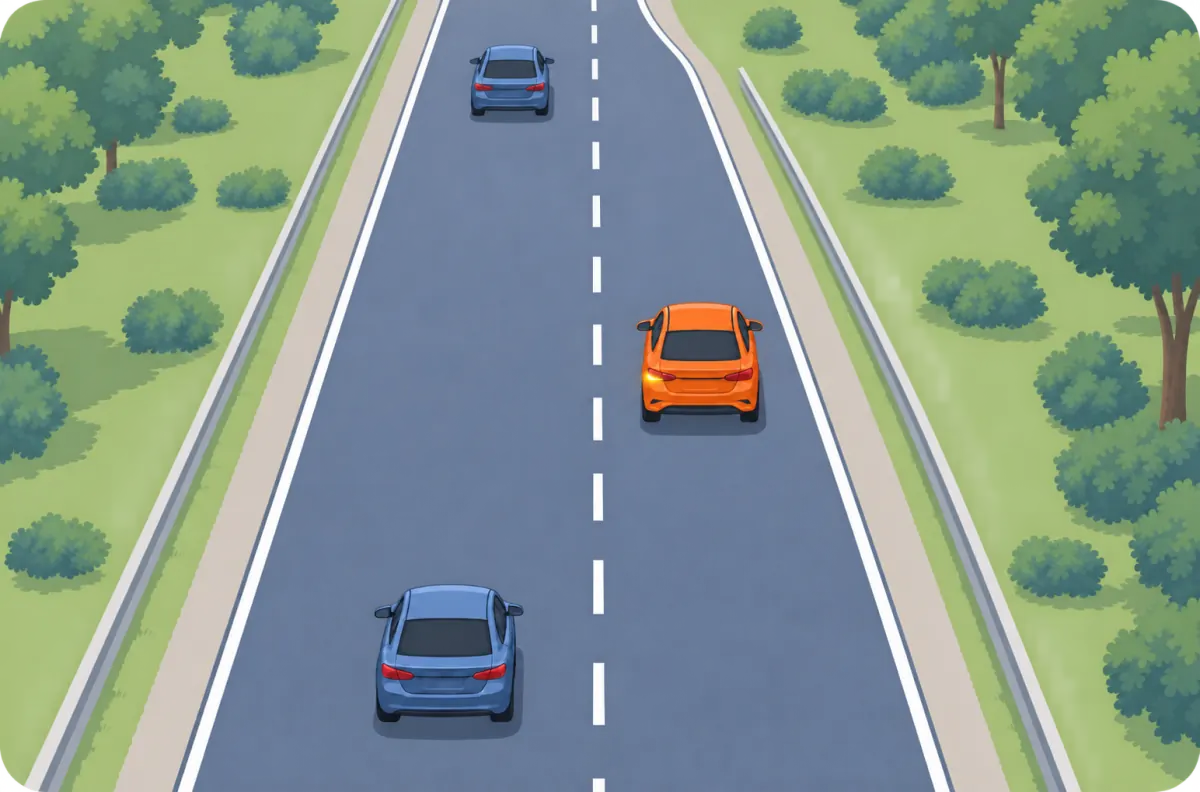
The G road test includes driving on major roads and expressways, so you need to enter, merge, change lanes, keep a safe speed and gap, and exit smoothly. Before the test you must also declare at least five highway trips from the last three months, or your appointment is cancelled.
Declare your highway experience first
You can't take the G road test without enough recent highway driving. DriveTest requires you to declare how many times in the last three months you have driven on a highway with a speed limit of at least 80 km/h or on a 400-series highway, plus the average length of those trips.
You need at least five trips in the last three months. The roads DriveTest lists include Highways 400, 401, 402, 403, 404, 405, 406, 407, 409, 410, 416, 417, 420 and 427, the QEW, the Don Valley Parkway, the Gardiner Expressway, the E. C. Row Expressway and the Conestoga Parkway.
For trip length, you choose under 5 km, 5 to 15 km, or over 15 km. The Official MTO Driver's Handbook calls the form the Declaration of Highway Driving Experience, and you complete and sign it before the test.
Cost of skipping it
If you don't have enough highway experience, the examiner declares the test out-of-order and cancels it. You lose 50% of your road test fee and pay that half again to rebook.
Entering and merging
A good merge starts on the ramp. The handbook says to check mirrors and your blind spot as soon as you can see freeway traffic coming from behind, while still watching any vehicles ahead of you on the ramp.
What the examiner looks for:
- Signal early. Turn on your signal as soon as freeway traffic can see you on the ramp.
- Control speed on the curve. Keep the ramp curve slow enough that people and objects in the car aren't pushed around.
- Match speed in the acceleration lane. Build up to the speed of freeway traffic, staying inside the lane markings.
- Pick your gap. Keep a two- to three-second distance from the vehicle ahead, and don't merge in beside another vehicle or into its blind spot.
- Merge smoothly. Move gradually into the centre of the nearest lane.
- Cancel your signal as soon as you have merged.
In heavy or fast traffic, the handbook says to adjust your speed to get the best spacing you can.
Speed and space on the highway
Once you are on the highway, the examiner watches how you manage speed and space. The handbook asks you to:
- Avoid speeding and avoid driving unreasonably slowly
- Drive at a steady speed wherever possible
- Look ahead 12 to 15 seconds for hazards you can avoid by adjusting speed
- Check your mirrors every 5 to 10 seconds
- Keep at least a two- to three-second gap, and add more if someone tailgates you
- Leave space on both sides, stay out of other vehicles' blind spots and avoid following large vehicles that block your view
Lane changes at highway speed
Lane changes are part of every G road test. The handbook breaks a lane change into clear steps:
- Look all around, dividing your attention between the road ahead, your mirrors and your blind spot.
- If there is a lane beyond the one you are moving into, check it too, so you don't collide with someone moving into the same space.
- Signal when there is enough space, early enough for traffic behind to react.
- Check your blind spot one more time.
- Match the speed of the new lane and move smoothly into its centre, with both hands on the wheel.
- Cancel your signal.
In heavy traffic, you may signal before a gap opens to show you are looking for space.
Exiting the highway
Exiting smoothly is its own task on the test. The handbook's exit task starts when you are in the far right lane and can see your exit:
- Check mirrors, and your right blind spot if there is a lane or paved shoulder to your right
- Signal before you reach the exit lane
- Enter the exit lane at its beginning with a smooth, gradual movement
- Don't slow down until you are completely in the exit lane, then slow gradually
- Don't cross solid lines between exit lanes
- Keep the exit-ramp curve slow enough for comfort and turn off your signal once you are on the ramp
Build highway experience during your G2 year
With a G2 licence, you can drive on all Ontario roads, including 400-series highways and high-speed expressways, without an accompanying driver. Use that freedom to log real highway time well before your test.
Aim for variety. Practise at different times of day and in different traffic and weather, as your licence allows. Include busy interchanges, short acceleration lanes and multi-lane exits, not just quiet stretches.
The Roadity iPhone app can help you rehearse. Its G practice routes near 19 Ontario DriveTest centres include spoken turn-by-turn guidance and hints at highway entrances, merges and exits, and it works through Apple CarPlay and Android Auto so directions stay on your car's screen. The examiner sets the real route on test day, so use the routes to build skill. Get it on the download page.
Quick highway checklist
Before test day, make sure you can do each of these without thinking:
- Signal on the ramp as soon as freeway traffic can see you
- Reach freeway speed before the acceleration lane ends
- Shoulder check before every merge and lane change
- Hold a two- to three-second gap at all times
- Scan mirrors every 5 to 10 seconds
- Stay in your lane and cancel signals promptly
- Wait until you are in the exit lane before slowing
For the rest of the test, read what to expect on the G road test, and take our free G lessons in the Library.
Questions
Do I have to drive on a 400-series highway on my G test?
The G road test includes driving on major roads and expressways, but the examiner chooses the route on the day. Which highway or expressway you use depends on the centre and the route.
What following distance should I keep on the highway during the G test?
The Official MTO Driver's Handbook says to keep at least a two- to three-second distance behind the vehicle in front, and more if someone is following you too closely.
When should I signal when merging onto the highway?
Turn on your signal as soon as traffic on the freeway can see your vehicle on the ramp, then turn it off once you have merged.
What happens if I don't have enough highway experience for the G test?
The examiner declares the test out-of-order and cancels it. You lose 50% of your prepaid fee and must pay that half again to rebook.
Sources
- DriveTest: Road tests for cars, vans and small trucks
- Official MTO Driver's Handbook: The Level Two Road Test
- Official MTO Driver's Handbook: Getting Your Driver's Licence
- Ontario.ca: Get a G driver's licence: new drivers
- DriveTest: Road test vehicle requirements
Checked November 8, 2026. Rules and fees can change; confirm with DriveTest or ServiceOntario before your test.